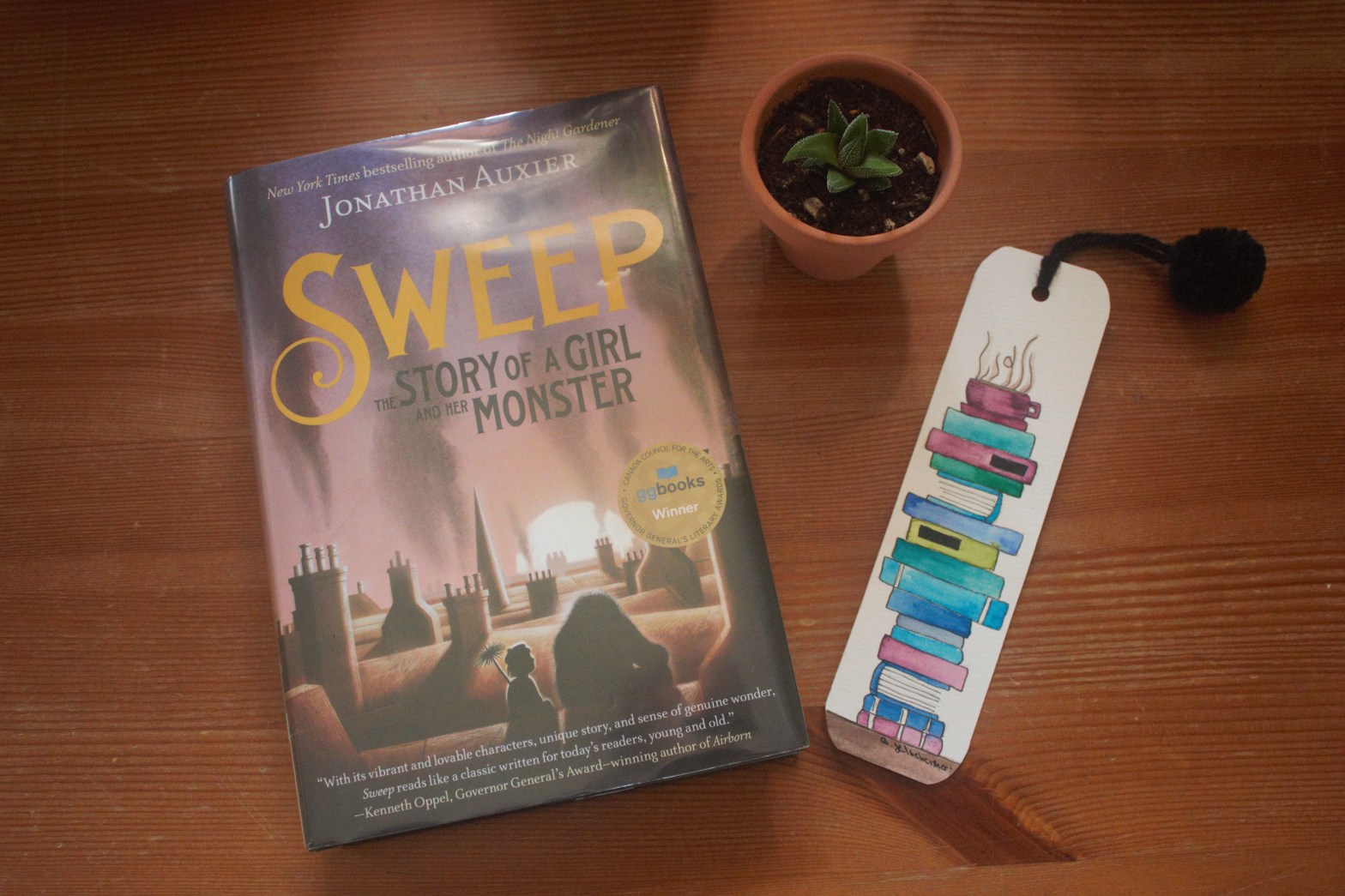
As a writer, I’ve found it valuable to read books from a writer’s perspective: to pay special attention to plot, diction, structure, and literary devices. In other words, what makes a good book good?
Recently, I had the opportunity to write a style analysis of one of my new favourite middle-grade books: Sweep: The Story of a Girl and Her Monster. Here it is:
“And even though they had eaten nothing, the girl still ended her day with a belly full of story—which sticks to the ribs even better than mutton.”
Sweep: The Story of a Girl and Her Monster by Jonathan Auxier, Page 59
Sweep: The Story of a Girl and Her Monster is a middle-grade historical fantasy novel by Jonathan Auxier. It tells the story of Nan Sparrow, a twelve-year-old girl who is forced to climb chimneys for a cruel chimney sweep. One day she is trapped in a chimney fire but is rescued by a monster, a soot golem.
The rest of the novel follows Nan’s growing friendship with her monster, Charlie. Though I’ll try to keep the analysis spoiler-free, if you sound interested and want to be completely surprised, I suggest you stop reading here as we dive into Sweep from a writer’s point of view.
Structure
Auxier structured his novel into two parts: “Innocence” and “Experience,” referring to collections of poems that play an important role in the story: Songs of Innocence and Songs of Experience. The novel reflects these themes through Nan’s journey in the story and the two voices that reflect innocence and experience.
The first voice narrates the story in the present, and it often utilizes shorter, blunter sentences for effect to reflect her bleak and miserable circumstances (Experience). The second voice narrates chapters about the Sweep. Nan’s dreams and memories of the Sweep are full of wonder and comfort (Innocence), and those chapters are written lyrically and formally in a way that reminded me of an old book. At the start of the story, the two parts feel distant, but as the plot unfolds, the connection between the memories and Nan’s present becomes clear.
Style
Jonathan Auxier is a master of rhetorical devices. He ties his story together with deft motifs, and alludes to many famous literary texts including William Blake’s poetry, the Bible, Frankenstein, and works of Shakespeare.
One of my favourite moments in Sweep is a stunning example of personification:
“Oh, no,” Charlie said. “I melted the star.”
“That wasn’t a star,” Nan said. “It was snow.“
“What is snow?” Charlie asked.
“Snow is…” Nan stared up at the pregnant sky. “You’ll find out tomorrow.”
Sweep, page 153
There are countless other literary devices worth mentioning:
Asyndeton:
“Burning, falling, starving, dying.”
Sweep, page 218
Anaphora:
“All in pretty bows.
All seated at pretty wooden desks.
All staring at her.”
Sweep, page 37
Alliteration:
“their smokestacks black against the setting sun.”
Sweep, page 255
Metaphor and Simile:
“The late-autumn sky was a cauldron of swirling gray… Dead leaves danced across the streets like brittle phantoms.”
Sweep, page 86
One of the most unique aspects of Auxier’s writing are the poetic and lyrical elements he weaves seamlessly into his stories, composing an almost dreamlike tone through unique formatting (90, 331), songs (35), choruses (30), riddles (40), and poetry:
“Feathers and bone without and within,
I am that and this and that once again.
Borne aloft among the winds,
I encircle new life within my limbs,
I bear the seed that bears the seed—
And by spring’s end, small mouths I’ll feed!
What am I?
Sweep, 163
All these literary devices work together to create the unforgettable voice that makes this story so captivating.
Final Thoughts
“It makes me believe that the world is full of wonders that I can scarcely imagine… Like every day was a miracle.”
Sweep, page 293
Sweep is sometimes heartbreaking, sometimes funny, sometimes sad, but ultimately full of hope. It faces hard topics of poverty, child labour, and anti-Semitism, and it opened my eyes to a part of history I’d never heard about. The historical note is a valuable deeper insight on the historical context, and the author’s note gives an interesting glimpse into the things that inspired and aided Jonathan Auxier in his writing.
Sweep is easy for middle-grade readers to understand, but like any good children’s story, it can be enjoyed by older readers too—who may appreciate the depth in it even more.
It’s a beautiful story about sacrifice and friendship, life and loss, miracles and love. In a world full of stories, this one leaves you breathless in wonder. Sweep is a timeless book for readers young and old.
Works Cited
Auxier, Jonathan. Sweep: The Story of a Girl and Her Monster. Amulet, 2018.

